Let us all rejoice in the Lord, keeping a feastday in honor of the Blessed Virgin Mary, for whose celebration the angels rejoice and unite in praising the Son of God.
*Ps 44:2*
My heart overflows with a goodly theme; as I sing my ode to the King.
Glory Be to the Father…
Let us all rejoice in the Lord, keeping a feastday in honor of the Blessed Virgin Mary, for whose celebration the angels rejoice and unite in praising the Son of God.
O God, Whose only-begotten Son, by His life, death and resurrection, has merited for us the grace of eternal salvation, grant, we beseech You, that, meditating on those mysteries in the most holy Rosary of the Blessed Virgin Mary, we may imitate what they contain and obtain what they promise.
Through the same Christ our Lord…
Lesson from the book of Proverbs
*Prov 8:22-24, 32-35.*
The Lord begot me, the firstborn of His ways, the forerunner of His prodigies of long ago; from of old I was poured forth, at the first, before the earth. When there were no depths I was brought forth. So now, O children, listen to me; happy those who keep my ways. Hear instruction, and be wise, and refuse it not. Happy the man who obeys me, watching daily at my gates, waiting at my doorposts; for he who finds me finds life, and wins favor from the Lord.
*Ps 44:5, 11-12.*
In the cause of truth and mercy and for the sake of justice: may your right hand show you wondrous deeds.
℣. Hear, O daughter, and see; turn your ear; for the King shall desire your beauty. Alleluia, alleluia.
℣. The solemnity of the glorious Virgin Mary, of the seed of Abraham, sprung from the tribe of Juda, of the noble line of David. Alleluia.
Continuation ☩ of the Holy Gospel according to Luke
*Luke 1:26-38*
At that time, the angel Gabriel was sent from God to a town of Galilee called Nazareth, to a virgin betrothed to a man named Joseph, of the house of David, and the virgin’s name was Mary. And when the angel had come to her, he said, Hail, full of grace, the Lord is with you. Blessed are you among women. When she had heard him she was troubled at his word, and kept pondering what manner of greeting this might be. And the angel said to her, Do not be afraid, Mary, for you have found grace with God. Behold, you shall conceive in your womb and shall bring forth a Son; and you shall call His name Jesus. He shall be great, and shall be called the Son of the Most High; and the Lord God will give Him the throne of David His father, and He shall be king over the house of Jacob forever; and of His kingdom there shall be no end. But Mary said to the angel, How shall this happen, since I do not know man? And the angel answered and said to her, The Holy Spirit shall come upon you, and the power of the Most High shall overshadow you; and therefore the Holy One to be born shall be called the Son of God. And behold, Elizabeth your kinswoman also has conceived a son in her old age, and she who was called barren is now in her sixth month; for nothing shall be impossible with God. But Mary said, Behold the handmaid of the Lord; be it done to me according to your word.
*Ecclus 24:25; 39:17*
In me is all grace of the way and of the truth, in me is all hope of life and of virtue. Like a rose planted near running waters I have borne fruit.
Grant us, we beseech You, O Lord, to be properly prepared to offer these gifts, and, through the mysteries of the most holy Rosary, so to keep in mind the life, passion and glory of Your only-begotten Son, that we may be made worthy of His promises.
Who livest and reignest with God the Father…
*Blessed Virgin*
It is truly meet and just, right and for our salvation, that we should at all times, and in all places, give thanks unto Thee, O holy Lord, Father almighty, everlasting God: and that we should praise and bless, and proclaim Thee, in the Festivitate of the Blessed Mary, ever-Virgin: Who also conceived Thine only-begotten Son by the overshadowing of the Holy Ghost, and the glory of her virginity still abiding, gave forth to the world the everlasting Light, Jesus Christ our Lord. Through whom the Angels praise Thy Majesty, the Dominations worship it, and the Powers stand in awe. The Heavens and the heavenly hosts together with the blessed Seraphim in triumphant chorus unite to celebrate it. Together with these we entreat Thee that Thou mayest bid our voices also to be admitted while we say with lowly praise:
*Ecclus 39:19*
Break forth in blossoms like the lily, and yield a smell, and bring forth leaves in grace, and praise with canticles, and bless the Lord in His works.

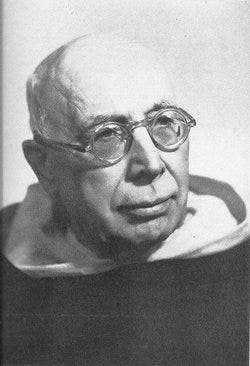 Father Santiago Ramírez, O.P. (1891-1967) | Source