
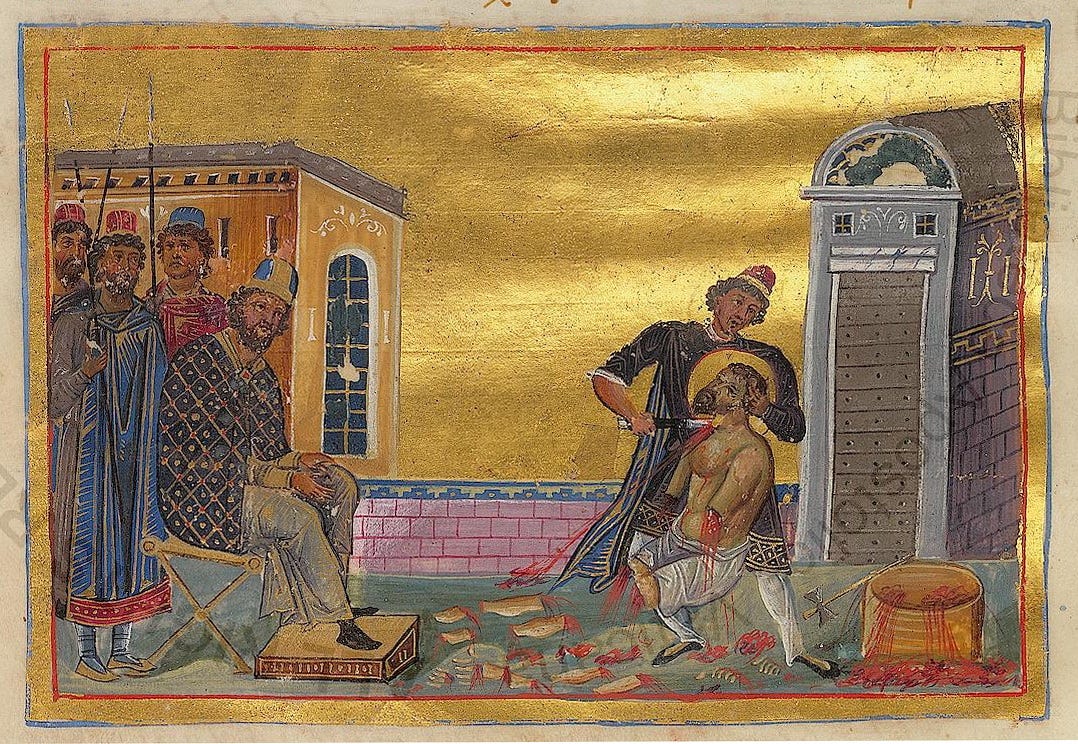
St. James was a native of Beth-Lapeta, a royal city in Persia, and a nobleman of the first rank, and of the highest reputation in that kingdom for his birth and great qualifications, both natural and acquired, and for the extraordinary honors and marks of favor which the king conferred upon him, and which were his most dangerous temptation. For when his prince declared war against the Christian religion,† this courtier had not the courage to renounce his royal master and benefactor’s friendship; and, rather than forfeit his favor, abandoned the worship of the true God, which he before professed. His mother and wife were extremely afflicted at his fall, which they ceased not every day bitterly to deplore before God, and earnestly to recommend his unhappy soul to the divine mercy.Upon the death of king Isdegerdes they wrote to him the following letter: “We were informed long ago that, for the sake of the king’s favor and for worldly riches, you have forsaken the love of the immortal God. Think where that king now lies, on whose favor you set so high a value. Unhappy man! behold he is fallen to dust, which is the fate of all mortals; nor can you any longer hope to receive the least succor from him, much less to be protected by him from eternal torments. And know that if you persevere in your crimes, you yourself, by the divine justice, will fall under that punishment, together with the king your friend. As for our parts, we will have no more commerce with you.”James was strongly affected by reading this letter, and began to reflect with himself what just reproaches his apostacy would deserve at the last day from the mouth of the great Judge. He appeared no more at court, shunned the company of those who would have endeavored to seduce him, and renounced honors, pomp, and pleasures, the fatal lure which had occasioned his ruin. We see every day pretended penitents forget the danger they have just been rescued from; lay their hands again upon the hole of the aspic which stung them before, and unadvisedly put their foot into the snare out of which they had just escaped. The very beasts which have been once taken in a gin, if they have broken it and recovered their liberty, by bare instinct never venture themselves again in that place. Infinitely more will every man who governs himself by reason or religion, or who sincerely abhors sin above all evils, fly all the approaches of his mortal enemy. This was the disposition of our true penitent; nor did he stick, in the bitterness of his grief for his crime, openly to condemn himself. His words were soon carried to the new king, who immediately sent for him.
Originally published in Padre Peregrino. Read original article