American Reform – The Theory of Education — Introduction to New Series

“And just as the principles of educational methods arose from religion, the inspiration of the sciences and the arts, so in their substance they were held to be immutable, like religion, truth, and ideal beauty. However, the books written by our ancestors, with exquisite wisdom, dispensed us from entering again into so many disquisitions, of which modern reformers wrongly boast.”>

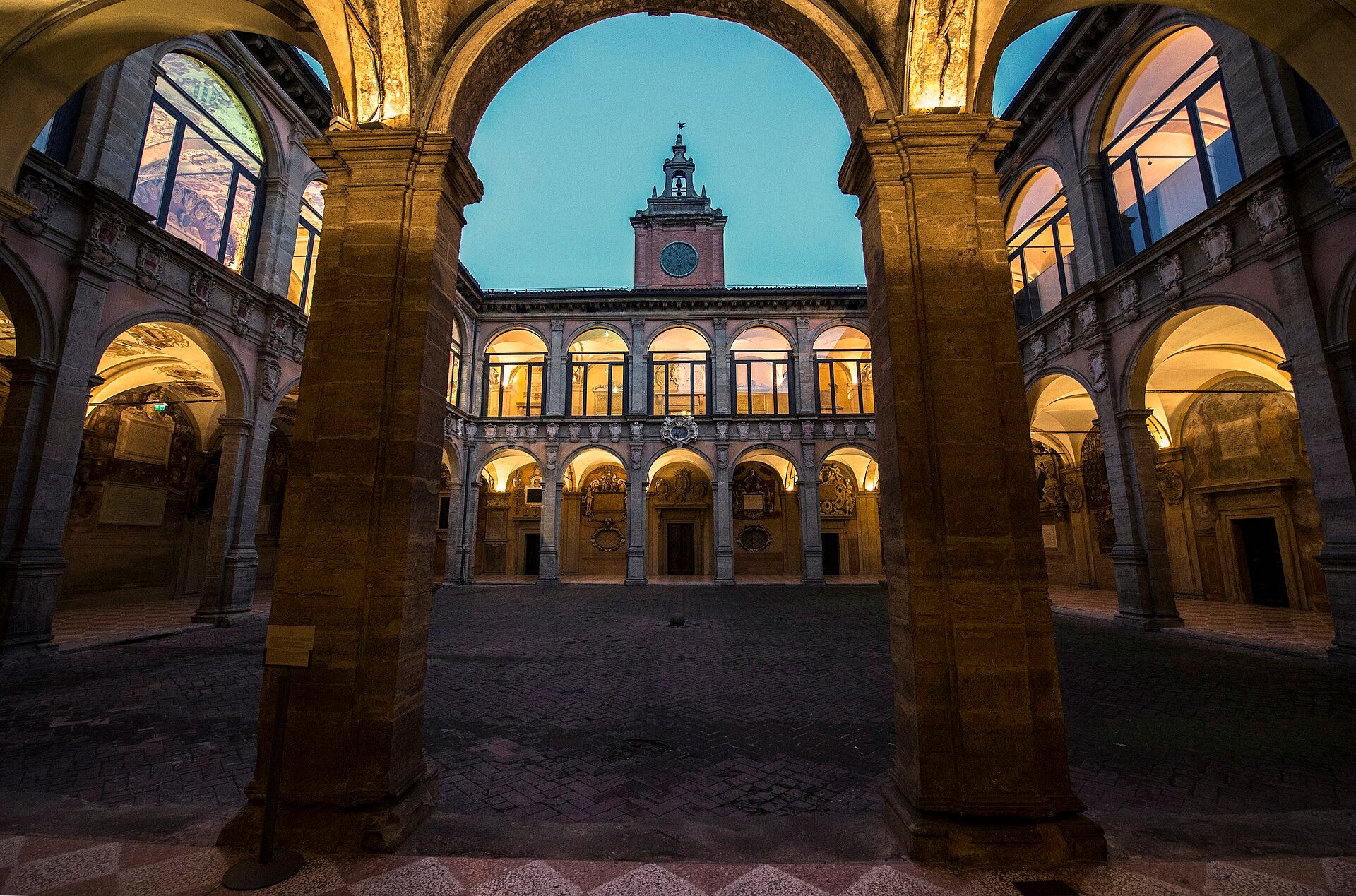
University of Bologna, Italy, established in 1088AD | Credit: Wwikiwalter

Introducing A New Series

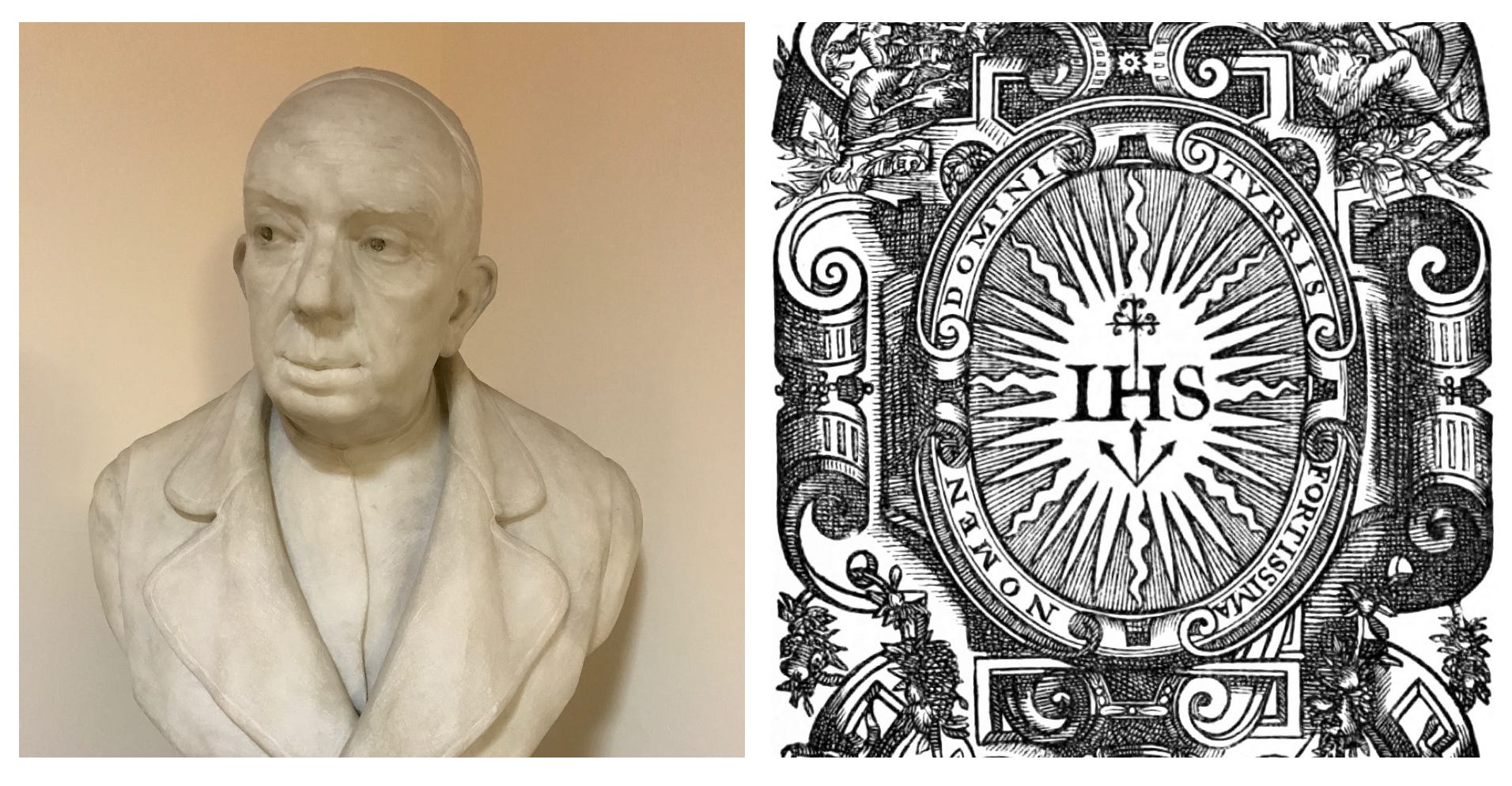
This year at The Journal of American Reform we continue to be focused on our project of “restoring all things in Christ”, keeping with the aim of Pope St. Pius X during his storied pontificate. Though our animating concern is the American political order, in order to enact real change, we must arm ourselves with the right principles, whatever the domain.>Naturally, that means the basics which, necessarily, includes education. In light of this, we are excited to introduce a new series on the proper theory of education, drawing from the Jesuits of La Civiltà Cattolica. An order that lays claim to being true masters of education, always importantly aligned with the directives of the Holy See.


Originally published in The Journal of American Reform. Read original article

American Reform – Contra Horn: Insufficient Opposition to Jewish Zionism and its Ambitions

>

“The Jewish claim to Palestine is implicitly a denial that they have disobeyed God and missed their vocation by their rejection of the Supernatural Messias. It is the assertion in action that the promised Messias has not yet come and that the day of their national domination over the world will yet dawn. The final result will inevitably be another disastrous blow to their hopes. All their naturalistic attempts to impose their will on God, instead of accepting His, are, needless to say, doomed to failure, and every failure involves the Jewish nation in dire catastrophes.” – Fr. Denis Fahey>

Earlier this week, the popular YouTube host and “Staff Apologist” at Catholic Answers, Trent Horn,1 chose to cover the recent controversy brewing around Carrie Prejean Bollet. Predictably, his analysis was a combination of both truth and error, mixed together with certain, key omissions.


Originally published in The Journal of American Reform. Read original article

American Reform – Friday Panel — Catholicism vs. Zionism, SSPX Update and Americanism vs. Integralism

The weekend is here and I have yet another great conversation to share, hosted by the intrepid on his YouTube channel. Unlike many Catholics today, we tackled the issues without equivocation and challenged modern taboos; notably Jewish hegemony, the Crisis in the Church and, finally, America’s liberalism problem.>


Please enjoy the conversation and let me know your thoughts in the comments!>


On the Docket

  • As seen in the news this week, Carrie Prejean Bollet’s anti-Zionist stand


    Originally published in The Journal of American Reform. Read original article

American Reform – The Godless Constitution: America’s Original Sin

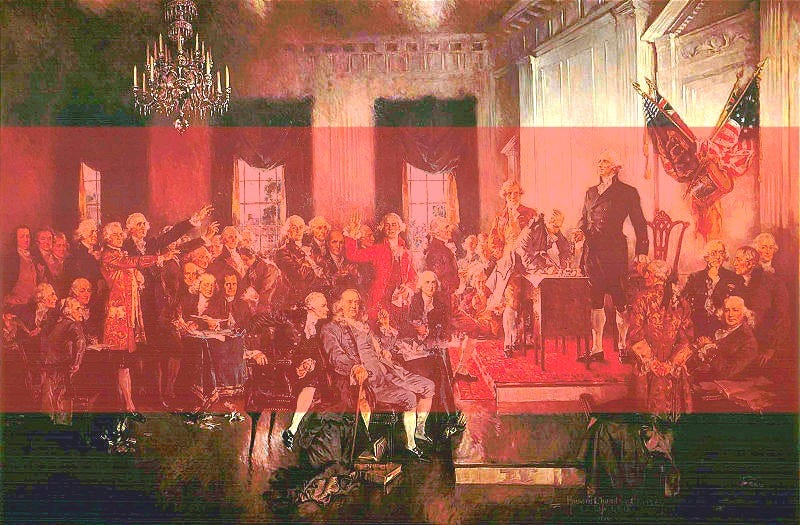
“In an unprecedented and rightly-described revolutionary act, the United States of America lays claim to the first major country in all of human history to design a godless government, i.e. one officially indifferent to religion, both natural and revealed. Established by the Constitution of 1788, it is, at the federal level, unconcerned with the rights of God, His Divine Son Jesus Christ, or any duties towards religion or a church — never mind the only true one.”>

Scene at the signing of the Constitution of the United States, Oil on Canvas, Howard Chandler Christy

Scene (edited) at the Signing of the Constitution of the United States, viewed through “rose-colored glasses” | Source

A Critique Born of Love

We hope by now, after having produced numerous essays that have been well-received at The Journal of American Reform critiquing modern errors, our readers will be no less enthusiastic when we turn our critical eye to our beloved country, the United States of America. Surely, the animating philosophy and spirit of one’s own homeland can and must be compared with sound philosophy and Catholic doctrine. In fact, to the extent there is divergence, the identification and correction of the error would be nothing other than true patriotism, the instinctive, noble and necessary love of one’s country.1 >Consider how you would judge a doctor who, so as not to further trouble his patient, allowed a deadly cancer to spread? If the same doctor were to repeatedly prescribe a program which lead to worsening of the poor man’s condition, would he not be considered insane? How, we ask, can anything other than the cure, radical yet entirely safe, approved by the best medical authorities be withheld — especially as the patient careens towards certain death?


Originally published in The Journal of American Reform. Read original article

American Reform – Against Liberal Conceptions of Society and the State — Liberatore, 1877

“From the Church, therefore, the State must receive the supreme moral rule, and consequently accept this Church and recognize it not as it pleases to conceive of it, but as God constituted it, respecting within it the rights and prerogatives that its divine Founder wished to bestow upon it. All this is perfectly self-evident and logical for anyone who acknowledges God.”>

Fish Do Not Realize They Are Wet — Nor Do Most American Catholics Realize They Are Liberal

There’s an old saying that goes something like “a fish does not realize he is wet”. This metaphor has aptly been used to explain the relationship between American Catholics and Liberalism. It is true. How else to explain the enormous difficulty of telling a man that his whole culture, education and environment is saturated with a poisonous ideology that does not readily announce itself. In America, keep in mind, the paradigm is ostensibly split between “Liberals” and “Conservatives”,1 and “Democrats” and “Republicans”, yet all of whom share the same, fundamental principles: namely the skepticism of authority, the primacy of the individual good over the common good, the exaltation of human liberty beyond its proper limits, the denial of the supremacy of the natural law and finally, the decoupling of society from the Church and revealed religion.>As in the example of the fish, who has no frame of reference for being “dry”, the American Catholic often has little — or perhaps none — experience with sound (read orthodox) political philosophy, which is intrinsically anti-Liberal. The remedy, of course, is to introduce our good-willed Americans to the stark opposition between Catholic doctrine and liberal principles, which has only been made worse by the ongoing crisis in the Church caused by the Second Vatican Council.


Originally published in The Journal of American Reform. Read original article

American Reform – Our First Interview of 2026 — Mitt brennender Sorge, the Catholic Church and the Third Reich

Merry Christmas and Happy New Year—for those of you that enjoy great conversations do we have a present for you! Tim Kelly, the veteran host of Our Interesting Times, had us on the program to discuss the oft misunderstood 1937 papal encyclical from Pope Pius XI, Mit brennender Sorge “On the Situation of the Catholic Church in the German Reich”.>

If you prefer listening to an audio-only version, as opposed to the YouTube link above, the conversation can be found on the platform Podomatic. Once again, we would like to thank Tim Kelly for inviting us on to discuss this much-needed reevaluation!>


Originally published in The Journal of American Reform. Read original article

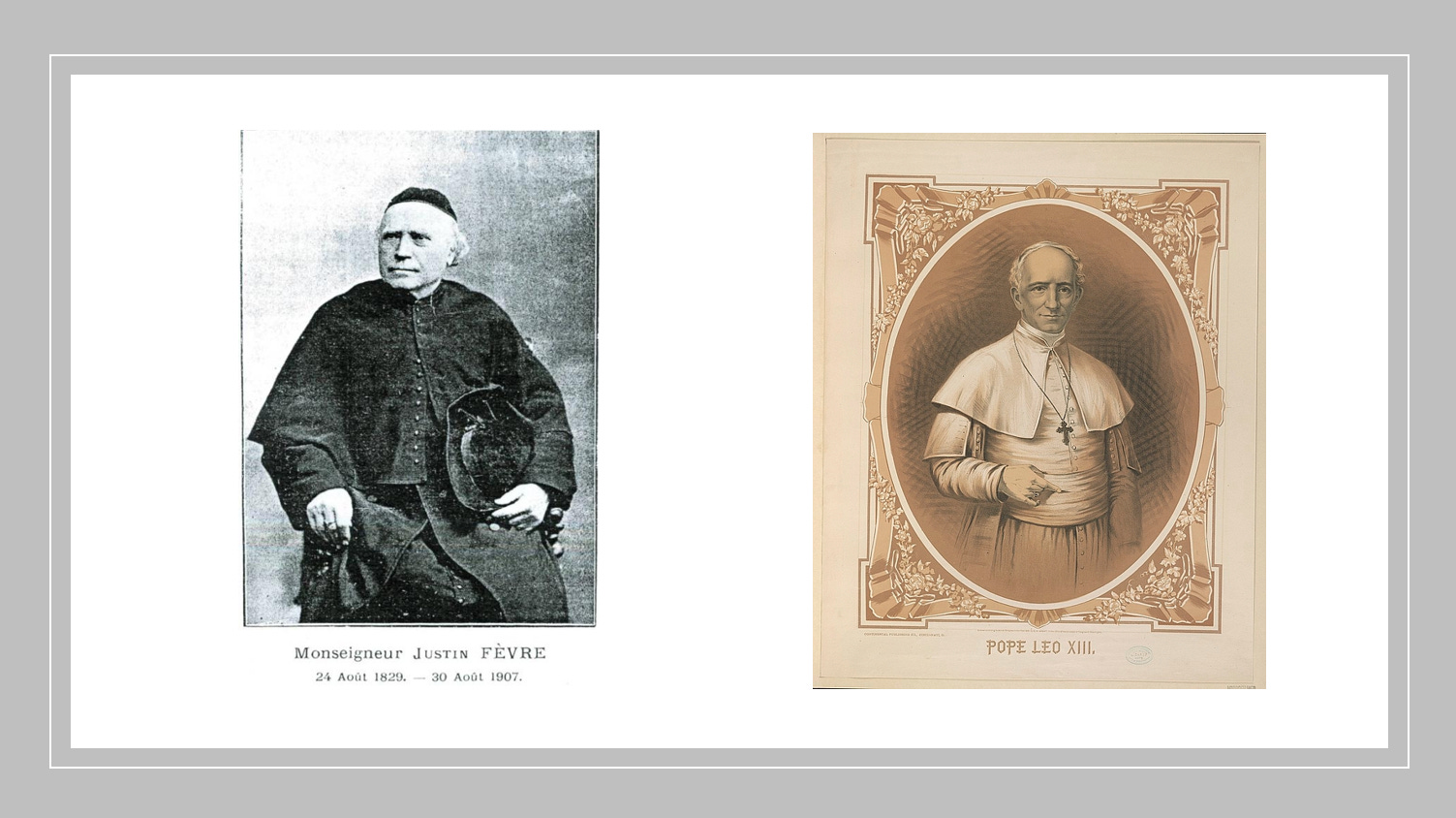
American Reform – Was Leo XIII, as is Often Said, a Liberal Pope? — Fèvre, 1907

“For a moment, some intelligent people… seemed to admit that the Encyclical Immortale Dei supported Dupanloup’s position. The Encyclical Libertas shattered these illusions. No, no, no; Leo XIII never uttered a single word, not a single word, that the partisans of liberalism could rightfully claim as their own.”>

Leonine Revisionism

Those misguided persons today who, in earlier times would be branded with the name “liberal Catholics”, sometimes attempt to present Pope Leo XIII (reigning from February 20, 1878, until his death on July 20, 1903) as an agent of liberalism, which is an absurdity to anyone with even a cursory knowledge of his pontificate. Others, more intelligent but possibly lacking in integrity, concede that Leo XIII was thoroughly anti-liberal in his magisterium, his doctrinal pronouncements and in the exercise of the papacy, but attempt to represent the august pontiff as sympathetic to their cause in the practical order. The Ralliement “Rallying” to the French Republic is the most [in]famous example. That said, is there any merit to this latter view and, if yes, to what extent?>Rest assured, the facts of history do not bear this out,1 nor will the contemporary testimony of our featured author, Monsignor Justin Fèvre, confirm this. Rather, his 1907 analysis dispels any such notion of liberalism on the part of Pope Leo XIII, either in the theoretical order (of course, impossible in his divinely assisted magisterium), or in the practical order. Importantly, Monsignor Fèvre begins his treatment by distinguishing between a liberal, properly understood and characterized by the adherence to revolutionary, rationalist and individualistic ideas, from the liberal man who displays the true virtue of liberality. The latter case is legitimate and not really the thrust of the accusation as we will see.


Originally published in The Journal of American Reform. Read original article
American Reform – Catholic Doctrine and “The Religion of the State” — Shea, 1950

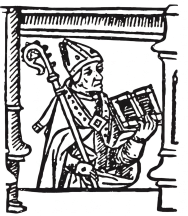
“What the philosophers and theologians have to say, relevant to the matter in hand, can be given only in resumé. That man has the duty not only of individual but also of social worship, is elementary Catholic doctrine . . . even the state, qua state, not simply ‘society’ but the politically organized community, civil society as such, is bound to profess religion, the true religion; to worship God in the way He wills to be worshipped; and is so bound by the natural law.”>

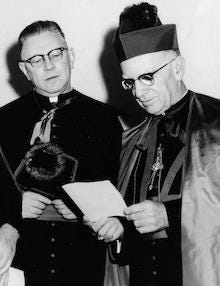
Monsignor George Shea, (1910-1990), rector (1961-1968), left; Most Reverend Thomas A. Boland (1896-1979), rector (1943-1947), Archbishop of Newark (1953-1974), right.

Monsignor George Shea, (1910-1990), rector (1961-1968), left; Most Reverend Thomas A. Boland (1896-1979), rector (1943-1947), Archbishop of Newark (1953-1974), right. | Source

>

Appreciating the Danger of American Liberalism

Before presenting the careful analysis of Fr. George Shea, later named a Monsignor, who is the focus of this essay, we must introduce the context and influence of the man whose ideas he was critiquing. The same man whose views on Church-state relations dominated the American church in the lead-up to the Second Vatican Council, none other than Fr. John Courtney Murray. A Jesuit theologian who, while in Italy in 1950, met with Msgr. Giovanni Battista Montini (later to become Paul VI) and found sympathy for his “orientations”, and whom Fr. Murray reported as wanting “his hand to be strengthened.”1


Originally published in The Journal of American Reform. Read original article
American Reform – Christmas Special! Politics and Culture with American Reform

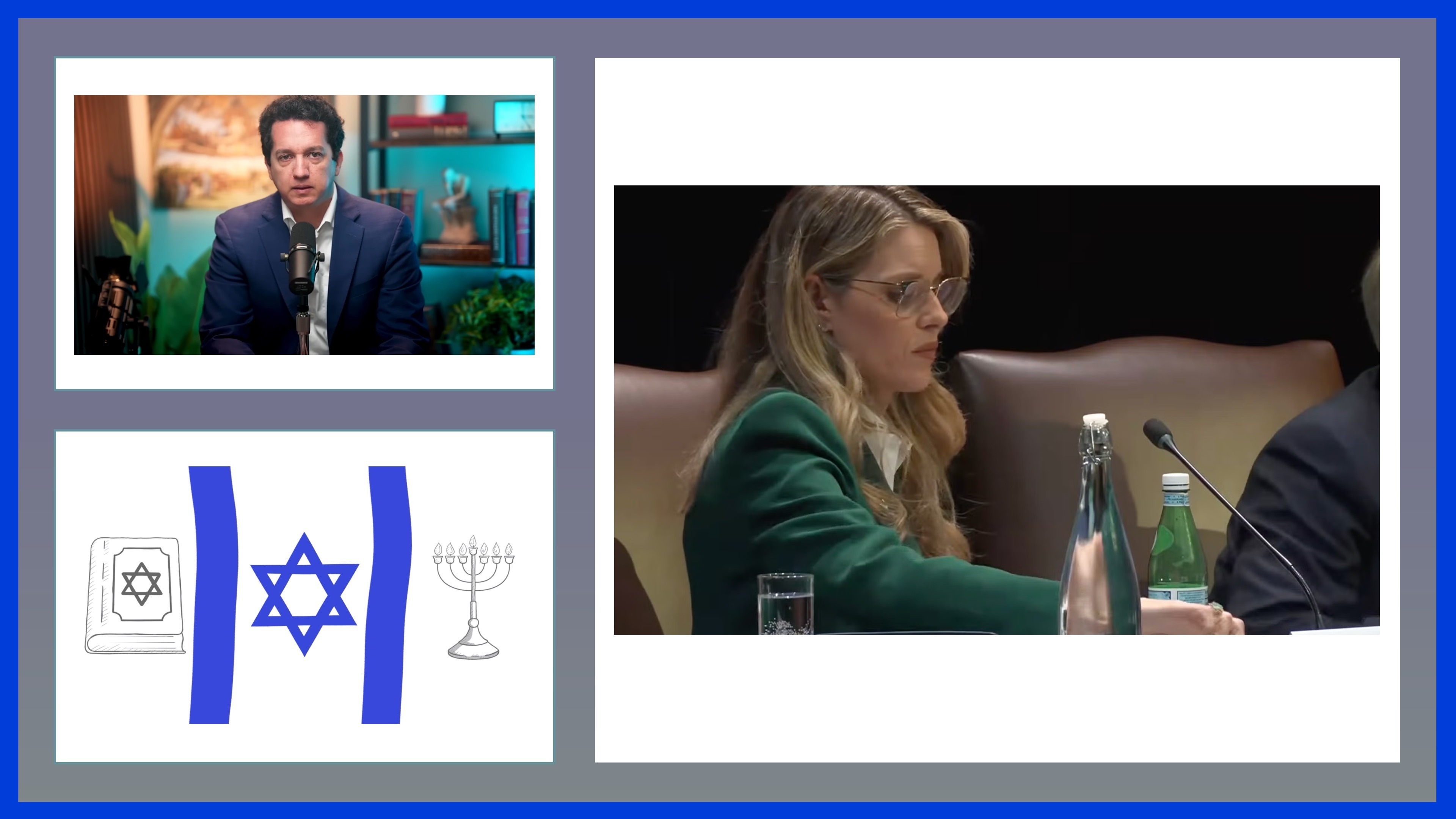
This episode was another great conversation between myself and Caleb, the host of The New Crusade, in what would be our second of 2025. If you missed our first conversation in July, consider listening to it below:>

As for this conversation, we delved deeper into topics we had already touched upon, while likely introducing new ideas to our audiences. The four main themes were as follows: relations between Jews and Christians, the American revolutionary founding, the false ideal of separation of powers and finally the declining American empire. At the very end of the episode, we took questions from the live audience and gave our advice to young Catholic men. The advice was primarily directed at those with “high agency” and a strong desire to create political change.


Originally published in The Journal of American Reform. Read original article
American Reform – The Precursor Signs of the Antichrist — Ballerini, 1881

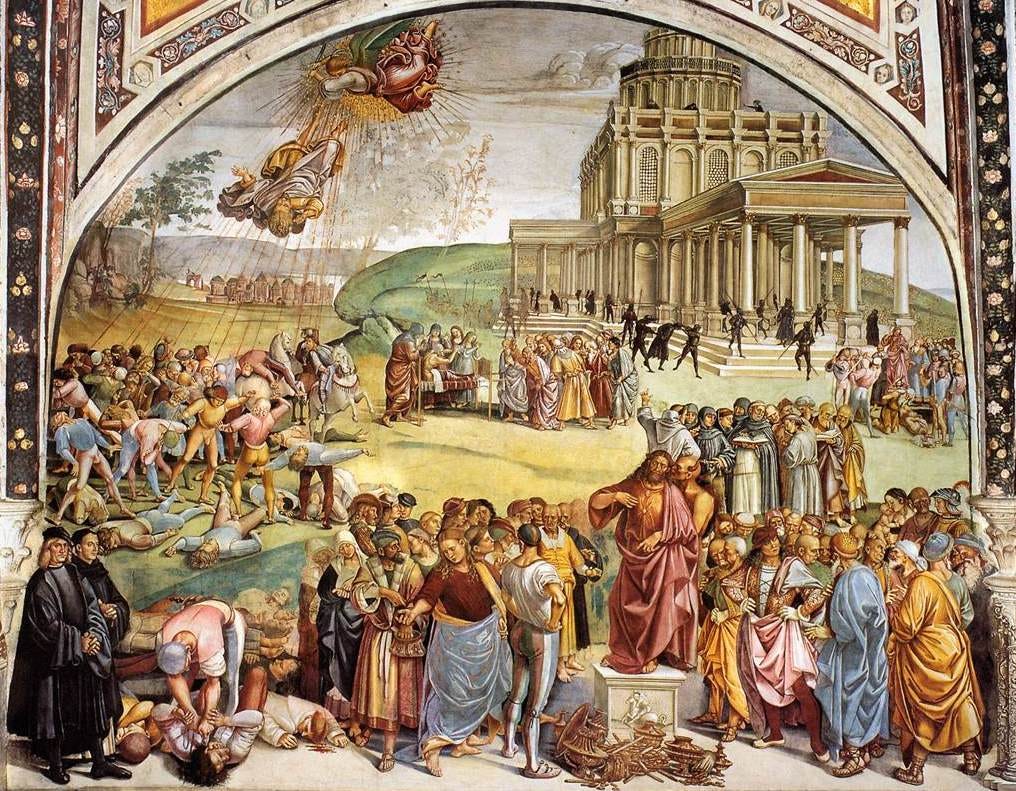
“We, not wishing on the one hand to be lengthy, and on the other to venture down rough paths, will limit ourselves to expounding the best-reasoned opinion of some learned and acute Catholic thinkers, who in our day have deeply investigated the course of past and contemporary historical events, and compared them with the biblical signs heralding the reign of anti-Christianity.”>

undefined

“The Preaching of the Antichrist” by Luca Signorelli | Public Domain

Prefatory Remarks

For many Catholics, the end of the world and the coming of the Antichrist are among the most interesting topics to study and talk about, and we confess that we are no exception. However, this branch of theology—properly called eschatology and coming from Greek: eschatos (ἔσχατος) meaning “last,” “final” or “uttermost”—is fraught with danger, in that no man knows the day or hour of his death, let alone the exact chronology of the end of the world and the events which precede it. In light of this, we were warned in Sacred Scripture (1 Thess. V, 1-2) about an unhealthy curiosity surrounding these subjects, yet in the same Divine Revelation are revealed certain markers by which we may carefully observe the “signs of the times”. These signs serving as a warning to the faithful and rule for the Church, by which we may prepare for those terrible days.>Noting that we must be on guard against making private judgments, i.e. those inconsistent with the mind of the Church and her approved theologians, or assigning certitude to that which is merely—more or less—probable, we do feel compelled to publish on this topic in The Journal of American Reform. Rather than merely presenting our own opinions, we will turn to the writing of a serious nineteenth-century Jesuit theologian, Fr. Raffaele Ballerini. Readers may remember him from two other essays and commentary we published on a separate, albeit indirectly related topic, the Jewish Question:


Originally published in The Journal of American Reform. Read original article